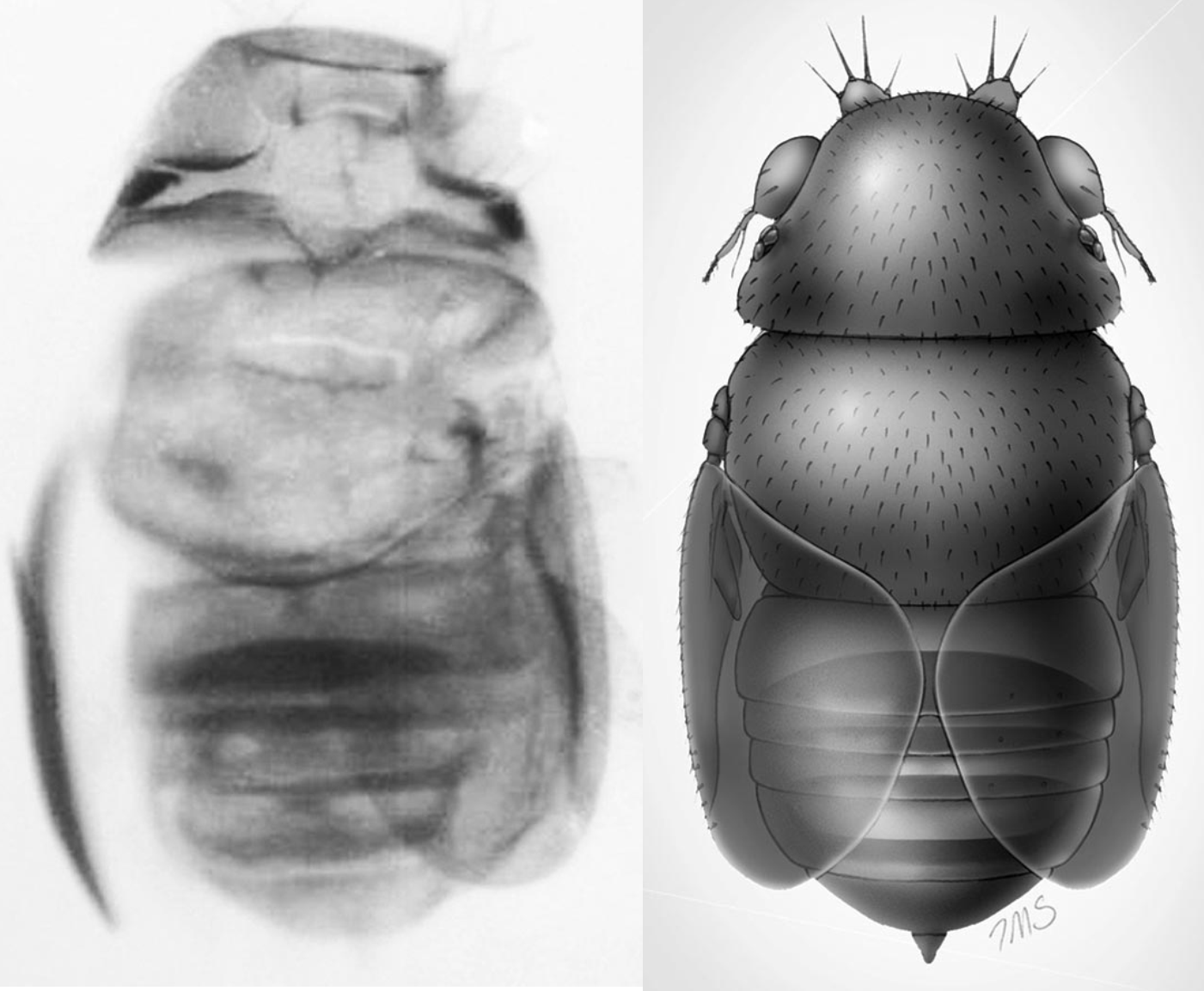
Longtime readers might know I have a bit of an affinity for a specific family of flies, the Phorid flies. I think they’re cool because many have either decomposer or parasitoid habits. The last time they were in the news, it was because a North American species had been discovered to be parasitizing honeybees in California. However, they ended up in the news again while I was traveling in Ecuador. Frank and I are working on a 5 part article on our travels, but first let’s discuss ant-decapitating flies.
I briefly discussed why I think phorids are so neat in Apocephalus borealis, a new threat to honeybees? but wanted to touch on it again. Many of these guys are decomposers. One very common member of this group, the Megaselia coffin flies, will lay their eggs on anything stinky and are often found around neglected trashcans and are sometimes confused with fruit flies. Like any large insect family, there’s a diversity of life cycles and not every species fits this mold. My last phorid-centered article focused on the genus Apocephalus, whose larvae feed inside the body cavities of honeybees. Some phorids, however, have much more specific niches.
If you look closely at the pictures in the Apocephalus article, you’ll notice that the fly is pictured laying it’s eggs in the butt (abdomen) of the honeybee. I don’t think it’s been investigated what this species is feeding on inside the bees, but the pictures offer me some clues. Since there are multiple larvae that are relatively large emerging from the bee, and because the bees are able to fly and navigate while infected I would very tentatively guess that they’re feeding on the bee’s abdominal tissues. The fact the bees are able to fly and navigate implies to me that the head and the tissues contained in the middle segment may be safe as there would be trouble navigating and difficulty foraging if the flies consumed these tissues.
However, not all parasitoids feed on abdominal tissues. Parasitoids will consume many parts of their hosts. Watch this video from the University of Florida to see what I mean:
See how those flies are hovering around the heads of the ants? That’s where they lay their eggs… in the heads of their hosts. They approach them from behind and jam their ovipositior where the head and ‘neck’ meet and inject their eggs directly into the ant’s head capsule. The larvae of the fly then hatch and hollow the head out, consuming the muscles and brain. Those ants will eventually become dis coordinated and then start to wander aimlessly when the larva inside consumes the ant’s brain, as this is kind of the ‘default’ mode of decapitated insects. The ant’s head will eventually fall off when the maggot is ready to pupate because the larva releases an enzyme that causes this to happen. The fly will complete it’s development in the ant’s head by transforming into its inactive pupal stage, then emerges as an adult after a few more weeks. Most of this fly’s life cycle takes place in an ant’s head.
Ants come in all shapes and sizes. Some are quite large and can be well over an inch (~2.5 cm) like the Amazonian bullet ant (which I encountered a few weeks ago). Other ants are far smaller, and are less than the size of one of the commas on this page. As you could imagine, small ants mean small heads. Small heads mean small flies.
This finally brings me to the subject of this article, the phorid fly Euryplatea nanaknihali which was recently discovered in Thailand. It’s most likely an ant parasitoid that has the same lifestyle described above, as the only other species in this genus has been confirmed to have this lifestyle in African ants. The fly is .4mm from the tip of the head to the end of the abdomen, which is smaller than most pencil leads which are .5 to .7 mm wide. In fact the fly was so small, the author mounted it on a microscope slide!

Now, I feel like I should mention that these are not the smallest insects in the world. Not by a long shot. In fact, there are wasps which are as big as some single celled animals, but it’s still pretty darn cool. It raises the question if this is some sort of coevolutionary arms-race with the ants trying to outdo the parasite by forcing them to be smaller and smaller over time.
If you’re wondering what the largest flies in the world are, the apparrent record holder is Gauromydas heros which has a bodylength of well over two inches. The larvae of this family appear to be predaceous but as far as I can tell nothing is known about the larval biology of this particular species.
Despite the fact the order Diptera contains some of the most medically important organisms in the world, critters like mosquitoes, black flies and sand flies, we know almost nothing about the majority of the flies. It’s a very humbling thought when you think about it.
Brown, B.V. (2012). Small Size No Protection for Acrobat Ants: World’s Smallest Fly is a Parasitic Phorid (Diptera: Phoridae), Annals of the Entomological Society of America, 105 (4) 554. DOI: 10.1603/AN12011
Image credit from original article: Inna-Marie Strazhnik


The world needs more Diptera…