
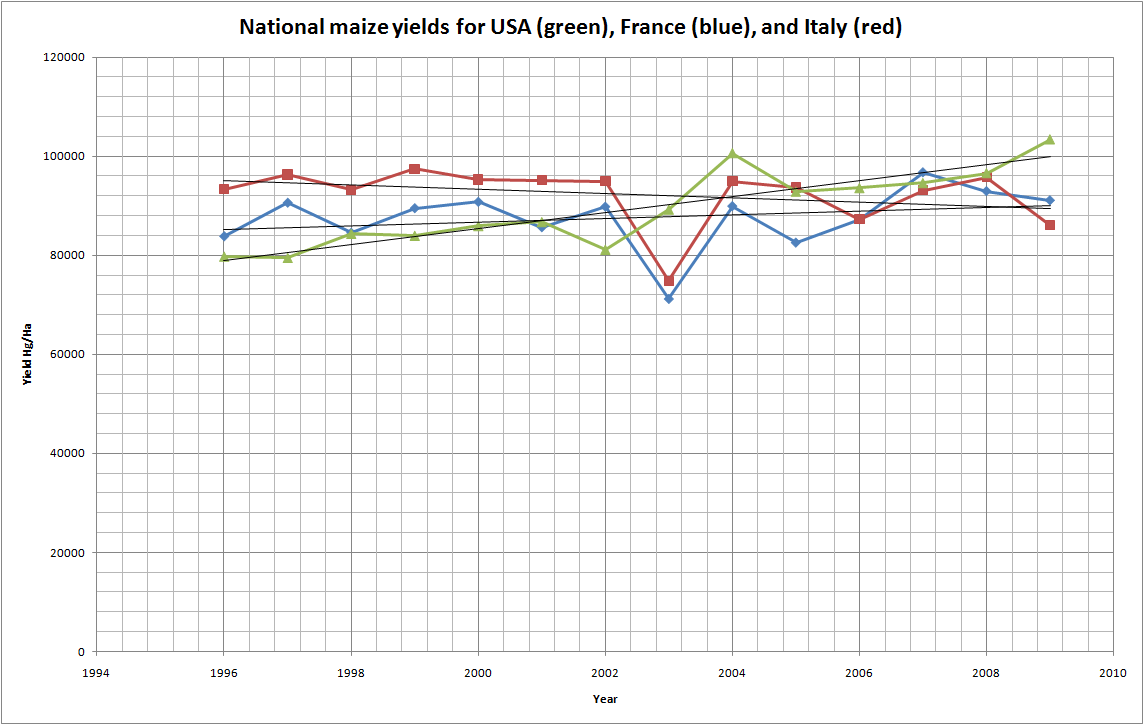
In an earlier post, we quoted Klaus Ammann’s investigation of maize yields and the differences between the United States and Europe in improvement in these yields over time.
This post provides an update of this story, showing encouraging recent progress in United States maize yields per hectare, as compared to a discouraging parameter for maize yield performance in the European Union. To represent the EU we use national statistics for France and Italy. The graphs are based on FAOSTAT statistics.
The United States is showing steady progress over time in national average corn yield per hectare, whereas the growth of maize productivity in the European Union has been stultified. During the same time period, biotech crops have been used extensively in the United States but are essentially banned in these two European countries.
Possibly the antitechnology stance in the European Union is is limiting the amount of investment in plant breeding that they can sustain. It also seems likely, given the growth of commercial agricultural biotechnology research in the United States, that there has been much more private investment in maize breeding in the United States than is happening in the European Union.

I’d like to see the graph normalized to average GDUs or somesuch – given how the France/Italy lines track each other pretty well across the whole timescale with France generally a tad below it would appear this is an issue (given that one would expect more GDUs in Italy than France given its more southern location) – while the differences could be driven entirely by acceptance/non acceptance of biotech I have a feeling that environmental differences play at least some role here.
Also what’s with having a non truncated y axis! The graph would look way cooler for us biotech advocates if it’d just focus on 60k – 120k
I agree. There’s other stuff happening that might not be due to biotech at all. And, are those lines significantly different? I think no.
“… And, are those lines significantly different? I think no.”
Ahhhhh! You guys are giving me warm and fuzzy feelings all over 🙂
Good calls, indeed.
Lack of error bars stymies any attempt to deduce significance – however an increase of 80,000 to 100,000+ Hg/Ha (Hectograms? Really?) is a pretty significant increase so I would assume there are at least significant changes from ’96 to 2009 although the big spikes (one of which happens in 09 in opposite directions for US and Europe) may be skewing the result somewhat – 2004 and 2009 both look like they had optimal weather conditions in the US, whereas ’03 clearly wasn’t a good year for Europe (historic heatwave probably did no good for the crops across the continent (so looking at GDUs wouldn’t even be the best idea here – the 2003 data at least should probably be completely excluded as no amount of technological investment up front could have forseen the summer of ’03) can’t find anything significant about 2009 summer – there did seem to be excessive snow in the winter (although this year looks worse already) which I guess may have had an impact (late planting etc)
Agreed, scale truncation is needed, and I’ve just cleaned it upa bit at GMO Pundit. Let’s see how long it takes to autocorrect here at Biofortified.
Anastasia has a good point about statistical significance. A couple more seasons may make this clearer.
If only people had planted corn earlier than 1996! =p (I know I know, age of biotech and all that jazz – can’t help but think the US already had more investment in germplasm up to that point though, what with the acreage advantage etc – I’m assuming the european higher yields at the start reflect corn only being grown in ideal situations and vagaries of the agricultural socialism in both theatres of corn)