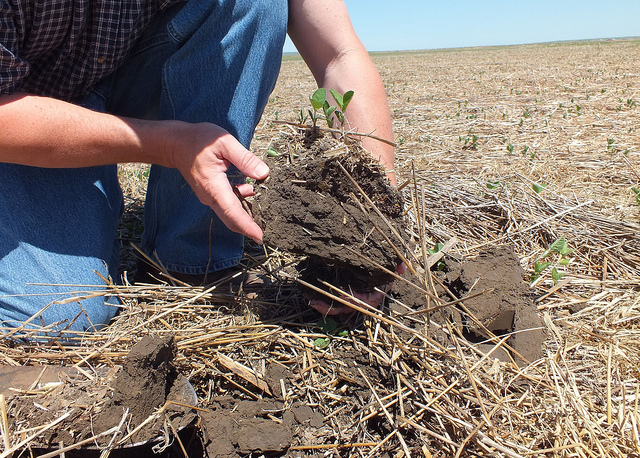
When I was a college student, almost every ag-related class I took mentioned the benefits of the “rotation effect” (better yields, fewer pests, etc.). However, aside from insect pests, how the “rotation effect” actually worked was always taught in only general terms, especially when it came to rotation effects in the soil. Recently, however, genetic methods are allowing soil scientists to begin to see what happens in the soil when a crop is grown. In their paper, Comparative metatranscriptomics reveals kingdom level changes in the rhizosphere microbiome of plants, Turner et al. describe the genetic tool they used, metatranscriptomics, and how they used it to get an “initial comprehensive picture of the [soil] community structure” in the plant rhizosphere.
Microbiome: the collective genetic information of the microbial community in an environment
Rhizosphere: the narrow region of soil that is directly influenced by root secretions and associated soil microorganisms (it’s the soil that sticks to plant roots when roots are carefully removed from the soil and lightly shaken)
To do this they grew wheat, oat, and peas in a Norwich, UK soil for 4 weeks. They then carefully removed the plants and separated the bulk soil from the rhizosphere soil. Next, using metatranscriptomics and lots of complicated data processing, they analyzed the life in the rhizosphere and bulk soils.

Here’s what they found:
Specific plant species change the soil community in specific ways. The microbiomes of the crops’ rhizospheres differed significantly from each other and from the bulk soil. And this was after only four weeks of growth – field differences are likely to be greater. These results are supported by research showing that oat and pea are good rotation crops for wheat – the shifts they produce in the soil probably contribute to the beneficial rotation effect. So, if you want to change your soil’s microbiome, change your crop.
Legumes are special. Legumes have always been known to be a good rotation crop – this research hints at why (besides nitrogen fixation effects). The data showed that the microbiome of the pea rhizosphere was much different from those of the cereals (oat and wheat), and that peas enhanced the rhizosphere for mycorrhizae better than the cereals.
The rhizosphere is where the rotation effect happens in the soil. The research found the differences between species in the rhizosphere. All the crops enhanced protozoa and nematodes in the rhizosphere. The bulk soil’s microorganisms were not changed by the plants.
Here are a few implications of all this.
What you grow matters, it changes your soil. Although these results do not give us guidance as to which crop sequences are most beneficial, the methods used may give us such information soon. Until then, follow the principle that diversity in crop sequences is beneficial. If possible, use non-crop species for cover crops and include legumes. It will be interesting to see if these methods can help us design species blends to accomplish specific goals.
How you grow your crop matters. Given the importance of the rhizosphere in these results, I have to wonder at the effect of tillage. Perhaps for monocultures it would be best to disturb the rhizosphere (or plant away from the previous crop row), but not in diverse crop sequences? In a no-till system, could you take better advantage of the changes that crops bring to the rhizosphere by planting so that newly planted seeds can send their roots down undisturbed root channels/rhizospheres of the previous crop?
As always, there is more complexity than we would like – the paper mentions new estimates of the diversity in soil: 50,000+ species of bacteria in a gram of soil. There is evidence that it is not just at the species level where differences can be seen in the rhizosphere, but also at the variety level. “Small changes in plant genotype can have complex and unexpected effects on soil microbes surrounding the roots,” states one of the authors. In addition, the changes to the rhizosphere brought on by crops may not always be beneficial. This study found that the pea enhanced root-knot nematode in its rhizosphere. So, while this new method is exciting and potentially powerful, the answers that will help us make agriculture more sustainable will still take a lot of hard work.
.
Turner T.R., Ramakrishnan K., Walshaw J., Heavens D., Alston M., Swarbreck D., Osbourn A., Grant A. & Poole P.S. (2013). Comparative metatranscriptomics reveals kingdom level changes in the rhizosphere microbiome of plants, The ISME Journal, 7 (12) 2248-2258. DOI: 10.1038/ismej.2013.119

It is sad to note that on a forum of this size and focus for AG that no comments have come in on this topic. I believe that this reflects the industrial monoculture status and trends so strongly emphasized on the forum. Understanding these types of soil fertility questions are what organic production is all about, yet ‘modern industrial AG’ is seemingly quite blind to this type of understanding and investigation. We try to oversimplify our understanding to the point of absurdity, and to ultimate reduction of AG science to ‘chemistry’ toward the exclusion of biochemistry.
It is sad to read the quote from the article:
“As always, there is more complexity than we would like.”
Our capacity would be enabled far better if we were to seeking with pointedly investigative attitude to find the complexity, and use it to inform our efforts toward agricultural wellbeing in the future.
Companion planting and succession planting knowledge complexity, present and future, holds incredible potential for increasing soil health for production and world supply into the future, yet they are largely tossed off as ‘quaint’ and unnecessarily complex when a few chemicals could be developed and applied to overcome all of this unnecessary complexity. Embracing the complexity and gaining vast understanding by studying it will be far better in the future than the current trends IMHO
Ray, I am not so sure about your explanation of the few comments on this. It is not controversial, it is just research results, and so does not elicit comments.
My lament for complexity is because the implications of 50,000 species of bacteria mean that we will not understand this anytime soon. Less complexity would be easier to understand, and hence make decisions about how to proceed, rather than the current state where understanding is a long way off.
Also, although the principles of organic production addresses these types of soil fertility questions, organic production chooses to avoid complexity, for the sake of marketing, through broad bans on any use of any synthetic fertilizers, pesticides or GMOs. A solution incorporating more complexity would instead ask, where could these tools be best put to beneficial use and where should they be avoided?