I recently saw an infographic that stated, “There are no life forms in the soil, which is sterilized…” What was it talking about? Soils on the moon? A toxic chemical spill? Soils around Chernobyl? Nope, this was the description of soils under so-called industrial agriculture. I have heard it before, the epidemic of “dead soils” caused by “chemicals.” This may make good copy for organic food advertisements, but it is not good science.

Soils are very hard to kill. Soil scientists wanting to sterilize soil have to expose it to high-pressure steam for 30 minutes or more in an autoclave. Often, because soils are notoriously hard to sterilize, they repeat the process more than once. It is hard to imagine how the killing power of an autoclave could be occurring in fields, regardless of management. Even fumigation, the most drastic of attempts to kill off soilborne pests, does not kill everything. The huge diversity of bacteria and fungi in soils, and the variety of microhabitats available to them, means that much life survives.
Soils are also very resilient. After fumigation, farmers know that they have a limited time before the pests and beneficial organisms rebound. Fumigating every year, rather than working better, tends to select for those organisms that use the applied chemicals as an energy source (they eat it). These organisms proliferate and diminish the effects of future applications. This should not be a surprise, after all, most pesticides are organic chemicals, and bacteria and fungi are experts at organic chemistry.
If soils are so resilient and hard to kill, why the talk about dead soils? I think much of it is just marketing hyperbole – “dead soils” stir emotions. However, there are soils that do not function well, that can seem dead. The cause of this problem is generally not “chemicals,” but rather a lack of organic matter, especially fresh organic matter.

Organic matter can be categorized by its age. Humus is very old (50-10,000 years) organic matter that is stable because it is highly resistant to further decomposition by soil organisms (the process of organisms extracting energy from, or “eating” organic materials). Material that is 5-30 years old is on its way to becoming humus, but can still be decomposed further by a select group of organisms. These two pools are large, but do not provide much food for the majority of soil microorganisms.
It is fresh organic matter, “the recently deceased,” that feeds the soil. When soils do not receive a regular supply of this fresh organic matter, biological activity decreases. The same can happen when soils are tilled often, which stimulates rapid decomposition. With no fresh organic materials to eat, the soil biology slows down and eventually many microorganisms go into a resting state. These soils are not dead, but they are starving. This view of organic matter and soil biology is simplified, but is useful for thinking about soil management and what soils really need.
A good place to learn more about organic matter and soil health is the book Building Soils for Better Crops, from the USDA Sustainable Agriculture Research and Education program, available in print or for download.

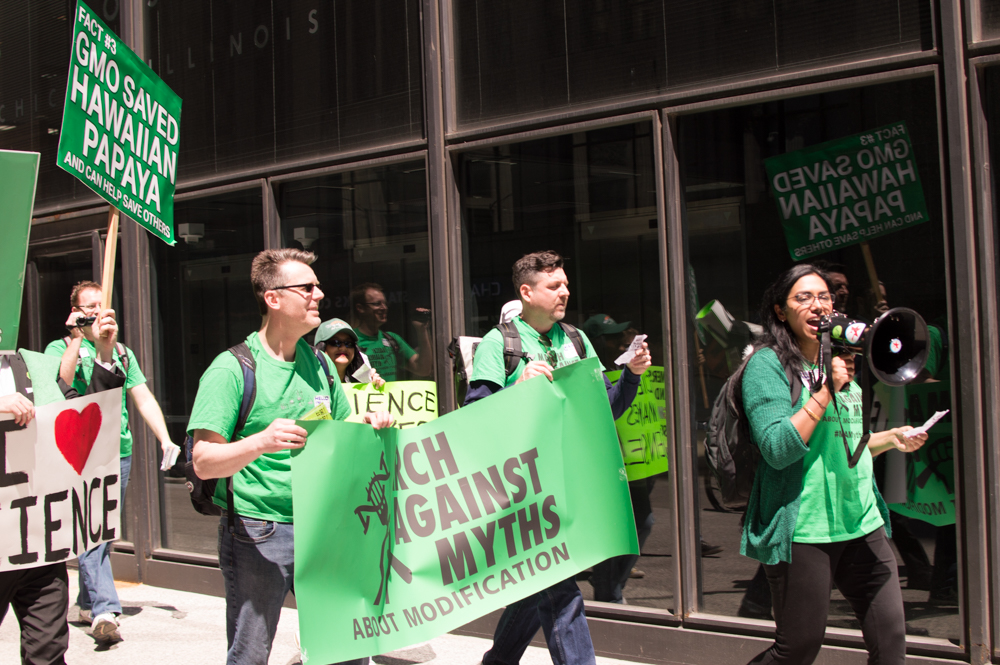


That inforgraphic is so extreme – the worst of the worst on the one side and the best of the best on the other side. The reality of farming is neither of these extremes!
Thanks for this brief look into the reality of soil – and thanks very much for pointing us to the Building Soils for Better Crops book. Hurray for free resources that are actually useful!
I thought the infographic was pretty good overall and it is a bummer they over-stated their case. Soils depleted in organic matter and with a history of aggressive pesticide use are highly diminished in terms of functional diversity, but technically not sterile. Bacteria tend to survive best with disturbance, but fungi and macroarthropods are reduced a lot, or so I recall.
Jason, I think there is more hyperbole than I’ve pointed out, for instance the statements that industrial agriculture “leads to massive unemployment…and gross gender imbalances,” (I thought that was Wall St banking?) and “causes mal-nutrition, heart disease, and obesity.” It also implies (at the top) that industrial agriculture is the reason that 1 billion people are hungry and another 1 billion overeat unhealthy foods. It uses sloppy terms, like “organic soil” – just what is an organic soil? And feel good statements like “maintains predator-prey relationships” that make it sound like if we just got it right, we could attain an agroecology utopia. As Anastasia says, its the “worst on the one side” and an agrarian dream on the other…not a good comparison for making informed decisions about how to improve agriculture.
Just because a soil isn’t 100% “sterile,” does that mean chemical fertilizers, pesticides and herbicides aren’t extremely damaging to the soil? Sure, there will always be some life in a soil, even after the harshest chemical applications, but that doesn’t mean those chemicals aren’t damaging the environment in a very real and drastic way. I will always believe less chemicals and more natural land management keep soil healthier.
Soil weakened (while not technically “sterilized”) by chemicals can wreak havoc on the environment. http://www.goodsweetearth.com/2013/09/10/record-amount-of-crop-losses-in-2012-bad-soil-practices-to-blame/
Hi Tom. In the big scheme of things that damage the soil, erosion is the #1 problem, much more than any chemical, synthetic or organic, fertilizer or pesticide. As the article says, erosion can be prevented by farmers using no-till farming and cover crops. Recommending these is a major part of my job.
However, the role of synthetic fertilizers in causing erosion is questionable, as is the role of organic fertilizers in preventing erosion. Without the residue cover that comes from no-till farming (which also makes the farmer more reliant on herbicides), bare soil is prone to erosion, no matter how it has been fertilized.
The article mentions tillage as a problem – I agree – but as I have pointed out in another post, https://biofortified.org/2013/10/hamstrung-by-ideology/, those organic farmers using “natural fertilizers” and not using synthetic pesticides have to use tillage, which makes a soil prone to erosion.
Erosion damages soil in a “real and drastic way”, chemicals, not so much, and they can even be part of the solution as with no-till farming.